
Contact: Stefan Benders
Introduction:
Magnetic resonance techniques enable the acquisition of many important process parameters such as phase distribution, material properties, flow, temperature and diffusion. While these are all highly relevant parameters, MR is furthermore to directly able to acquire chemical information through the chemical shift, routinely used in NMR spectroscopy.
The challenge is that, in MRI usually the chemical information is traded off in spatial encoding to accelerate measurements. Conventional spectroscopic imaging is therefore time consuming and not suited for the dynamic processes in reactors. By employing a priori knowledge, model-based approaches can employed to accelerate these measurements significantly. In medical research, these have been developed to assess fat/water content[1]. In chemical engineering, von Harbou et al.[2] showed that direct modeling and reconstruction from k-space can yield quantitative compositions.
This project builds upon this model and extends it. Together with our collaborators at the Institute of Biomedical Imaging, an acquisition pipeline using robust sequences was developed, which can map complex mixtures as well as account for field inhomogeneities, important for large bore systems. First results show improvement over established techniques such as echo planar spectroscopic imaging (EPSI) at an acquisition time of 24 s per map.
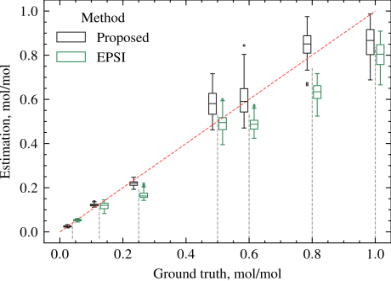
Chemical composition estimated by the method for a single tube with a water/acetone mixture.
Task description:
- Familiarize yourself with the reconstruction pipeline to recover composition maps from MR measurements
- Design experiments showcasing dynamic changes in chemical composition in well-suited systems
- Implement and explore acceleration techniques and different pulse sequences
Required skills:
- Good knowledge of programming languages (Python/Julia)
- Basic chemical understanding to identify suitable systems
- Basic knowledge of magnetic resonance
Journal publication related to the project:
Tsanda et al., Rapid quantitative chemical composition mapping using model-based MRI reconstruction with field inhomogeneity correction, submitted to Journal of Magnetic Resonance, https://arxiv.org/abs/2607.24441
[1] Grimm et al, European Journal of Radiology 103 (2018) 57-64 https://doi.org/10.1016/j.ejrad.2018.04.011
[2] von Harbou et al., Journal of Magnetic Resonance 261 (2015) 27-37 https://doi.org/10.1016/j.jmr.2015.09.013